


As a die-hard ice angler, watching the season come to an end is always difficult. Living in Iowa City, Iowa this frequently comes earlier than I would like. Most people would call the post-ice out month the “dog days” of fishing. For me, it ignites a yearlong built-up anticipation, and provides any cat-fisherman paradise.
For those on border waters of Minnesota, most anglers’ time is spent chasing the hot bite on the Rainy River for walleyes or sturgeon. For the rest of us, our time is spent preparing for our desired species season openers. I will admit, in southern Iowa we don’t have the broad selection of bodies of water and various species to target compared to the Dakotas, Wisconsin, or Minnesota. We do, however, have a catfish bite that isn’t believable until you experience it yourself.
The past few weeks I have fished the Coralville, IA reservoir and river system just north of Iowa City. With our annual winter shad die off, channel catfish eagerly leave their winter holes in search of warm, shallow water and ample amounts of an all you can eat shad buffet. This reservoir is extremely shallow (1-5 feet) and consists of only stumps and mud. Targeting them is relatively simple, but does require some insight on finding and catching them efficiently. This technique can be applied to almost any reservoir system in the Midwest seasonally, and even most rivers.
With water temperatures quickly rising post-ice out, catfish move shallow on reservoirs. By shallow, I mean 1-3 feet of water. I utilize a flat bottom boat with a mud motor when possible, but because most people don’t own or have access to this set up, fishing from a small (12-14 foot) johnboat with a 24-volt trolling motor (or higher) will work just fine. My set-up ran me $600 for the boat, batteries and 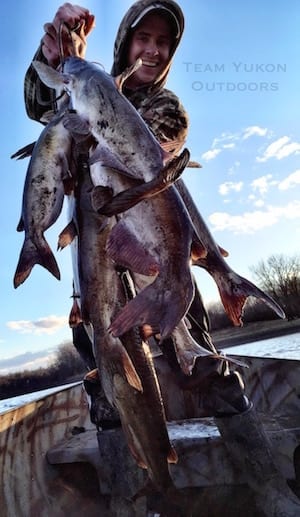 trolling motor, which surprisingly works very slick. I am able to run 2-3 people up and down river for a half day with battery power to spare. Any boat with a typical outboard engine with an intake will not work in such shallow water. Fishing from shore is also an option, given the right spot.
This time of year, your bait must match what the catfish are already feeding on. I collect rotten dead shad washed up on the banks of the reservoir or nearby small ponds. FYI: these shad STINK. The more rotted they are, the better. Fresh, store bought shad simply won’t work nearly as well. If you can’t find your own rotten dead shad, trying finding shad guts at a local bait shop, or even online — these will work just as well. Avoid using stink bait in any situation until the water temperatures are above 65 degrees. Colder water temperatures don’t allow the stink bait to disburse in the water.
After your bait is established it’s time to find some fish. During the peak of the bite (when shallow water temperatures reach about 45 degrees) I run my boat across 1-2 foot shallow mud flats with current. Watching and reading the river/reservoir bank as you go will help you predict water depth. Of course, fish finders can relay you the depth but are useless on finding fish in only twelve inches of water! After finding a promising shallow mud flat, I run my boat through it watching for fish to spook and make “V’s” in the water or even start busting on the surface. Yep, it’s that easy. After finding a school I anchor my boat 50 yards upstream and run six lines scattered downriver with a two-ounce weight, 3/0-5/0 hooks and any heavy rod and reel combination paired with 50-plus pound braid.
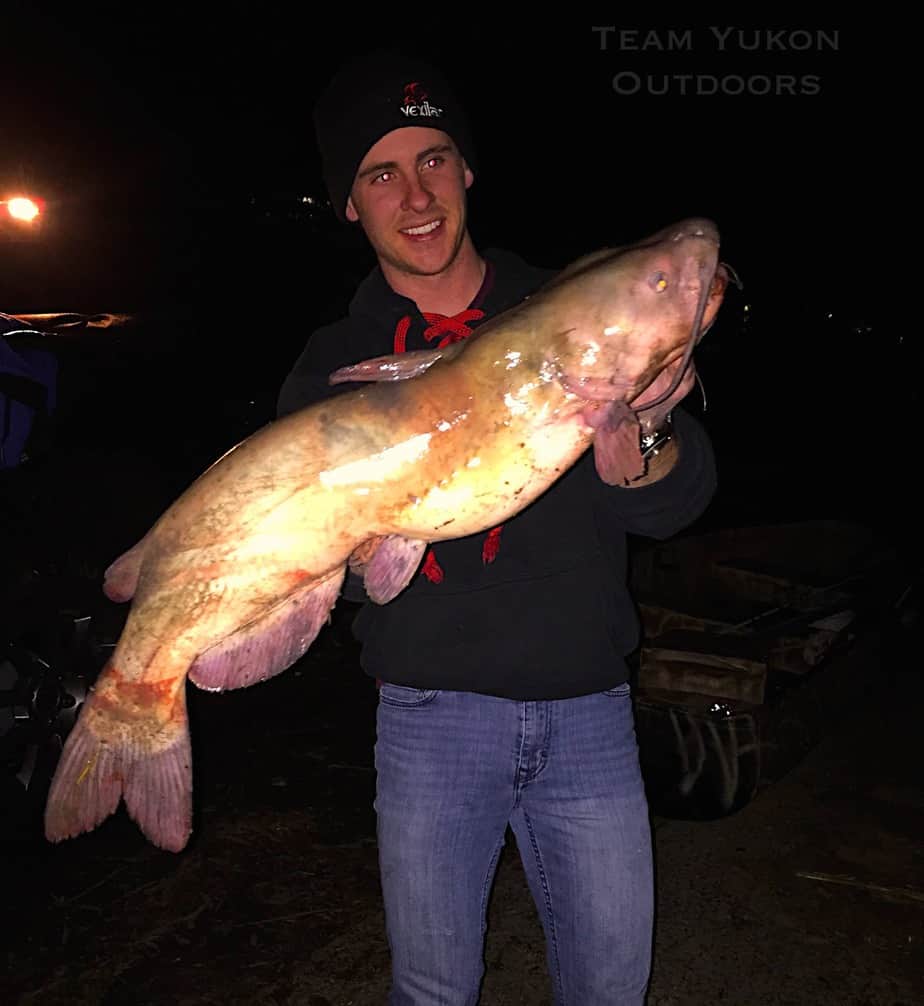
This year I rarely went longer then five minutes with out a fish on. Some cats even blew up on my bait similar to a bass eating a top-water (because it was so shallow). This type of fishing has me hooked for life. With cold-water temperatures and these cats ranging from two to fifteen pounds, they provide an extremely tasty meal.
Keep this technique in mind for the years to come, Channel cats are often overlooked, yet provide a tasty meal and fast-paced hook setting action.
Be safe and good luck on the water!
Nick Kerber
Team Yukon Outdoors



Comments are closed.