
Leech Lake has long been one of Minnesota’s most respected muskie waters; big water, big fish, and enough mystery to keep even experienced anglers guessing. But as fishing technology has changed, so have the questions. Forward-facing sonar has made it easier to locate individual fish, open-water muskie fishing has become more visible, and concerns around muskie handling, delayed mortality, and “sharp shooting” have pushed anglers, biologists, tribal leaders, and conservation groups to ask: What is actually happening with Leech Lake muskies?
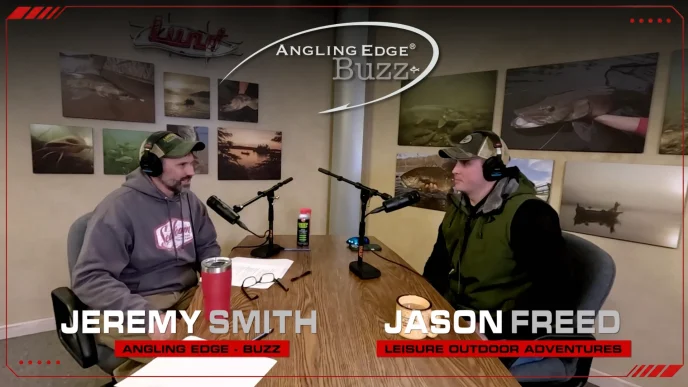
That question is at the center of the Leech Lake Muskie Movement and Survival Study, recently discussed with Baylor Short, a fisheries specialist with the Leech Lake Band of Ojibwe, lifelong Leech Lake angler, and graduate researcher. The early findings are already challenging long-held assumptions about how muskies live, move, and survive.
Meet Baylor Short
Short grew up fishing Leech Lake out of Walker, Minnesota, volunteered with the local DNR office at a young age, and earned a degree in aquatic biology before joining the Leech Lake Band of Ojibwe as a fishery specialist. When a former professor reached out about a master’s project focused on Leech Lake muskies, he couldn’t pass it up. He understands the lake as both a scientist and an angler, and the study reflects the same questions serious muskie anglers have asked for years.
What the Study Is Looking At
The project focuses on three areas:
- Movement — Where are muskies traveling throughout the season?
- Habitat use — How do they use rocks, weeds, sand, and open water at different times of year?
- Mortality — Are muskies dying after being angled, handled, or exposed to increased pressure?
It came together quickly as concerns grew around fishing pressure on Leech Lake, especially with anglers using modern electronics in open water. Rather than rely on dock talk, the people involved wanted real data.
How the Tracking Works
During spring egg-take operations in Miller Bay, fish were captured in fyke nets and tagged. Selected muskies received surgically implanted acoustic tags, plus external Floy tags (visible to anglers for reporting) and internal PIT tags.
Researchers track tagged fish in two ways. Active tracking is hands-on. Short on the water with headphones, a receiver, and a pole-mounted hydrophone, scanning frequencies and listening for pings, then using forward-facing sonar to pinpoint location and habitat. Early in the season, it took more than a week to find the first fish. Passive tracking uses receivers placed in strategic spots. Open-water zones, inflows and outflows, deep-water locations, and travel routes that log tagged fish swimming within range. Together, they reveal how muskies use the lake over time.
Early Findings: Roamers and Homebodies
One of the most interesting findings is how differently individual muskies behave. One large female traveled more than 20 straight-line miles over roughly two months, and that’s just between detection points, so the actual distance was likely much greater. That challenges the old belief that muskies are highly territorial.
The opposite was also true. A smaller male, around 32 inches, stayed tight to a specific area for much of the summer. Some fish are roamers, some are homebodies, and some may shift between patterns depending on season, size, forage, or spawning behavior.
Habitat and Water Column Use
After spawning, fish were first located on shallow rocks and weeds. As water warmed, some pushed into open water, then dispersed across rock piles, reefs, and sand. Weeds were used less heavily by tagged fish than Short expected, though anglers still reported fish in weed-related areas. Open-water muskies often related closely to baitfish, confirming what many modern anglers see on electronics: these fish aren’t limited to classic shoreline structure.
Short also observed muskies using large portions of the water column in open water, moving from deeper water to the surface and back within short windows. That shifts the conversation away from simple depth rules and toward a more complete understanding of fish stress. Depth matters, but so do fight time, water temperature, net time, and hook placement.
When multiple tagged fish showed up in the same spot, it was telling. With only 21 acoustic tags out in the lake, two or three in one area represented a meaningful concentration, and it confirmed something anglers have long experienced: certain spots “turn on” under the right conditions. So far, the clearest patterns have been seasonal rather than daily, with fish appearing in open water during parts of June and July, leaving, then reappearing as the water cooled in September and October.
Forward-Facing Sonar, Mortality, and Handling
The study came together partly because of concerns around forward-facing sonar. The technology lets anglers see and target individual fish in real time, which raises fair questions for low-density, slow-growing species like muskies. Short doesn’t frame the technology as automatically bad; he uses it himself in the research. The bigger question is how anglers use it.
Early mortality numbers aren’t alarming. Two tagged fish were considered mortalities at the time of the discussion, both tagged during spring trap-netting, neither reported caught by anglers. One was an older, large female that had spawned multiple times and may simply have been near the end of her life. Researchers can’t be certain a fish hasn’t expelled its tag, but the lack of movement suggests mortality.
The clearest immediate takeaway is this: better handling gives muskies a better chance, regardless of electronics. A few simple adjustments make a real difference:
- Cut hooks when needed instead of fighting to remove them
- Consider barbless hooks
- Keep fish in the water as much as possible
- Have release tools ready
- Minimize time in the net
- Avoid overhandling for photos
- Pay attention to water temperature and fish condition
Cutting hooks is one of the easiest wins. Some anglers hesitate because they don’t want to replace hooks on an expensive bait, but it dramatically reduces handling time, especially when a fish is tangled in the net or hooked with multiple trebles.
How Anglers Can Help
A related population estimate project relies on angler participation. Anglers have been asked to collect small fin clips from muskies they catch for genetic analysis, and roughly 380 clips were submitted this season. Every fish counts; clips from smaller muskies are just as valuable, since each one represents another individual in the lake. Reporting tagged fish and submitting fin clips are among the most direct ways anglers can support fisheries science.
Why It Matters Beyond Leech Lake
Muskie fisheries across the Midwest are facing the same questions about sonar, open-water vulnerability, delayed mortality, and movement. Leech Lake is an ideal place to study them. Large, complex, culturally important, with cooperation among the Leech Lake Band of Ojibwe, Minnesota DNR, Bemidji State University, local businesses, and anglers.
The study is still ongoing, but the picture so far is clear: Leech Lake muskies aren’t all doing the same thing. Some travel long distances, some hold tight, and many use more of the water column than once assumed. Forward-facing sonar is part of the conversation, but responsible handling remains the clearest way anglers can protect the resource. And for anyone who has spent time on Leech Lake wondering where the muskies went, the answer may be both frustrating and exciting: they may be closer than you think… or they may be 20 miles away.