

Ice Fishing 2026: New Gear, Early Ice Strategies, and Expert Tips with Brian “Bro” Brosdahl and Matt Johnson
Angling Buzz host Jeremy Smith sits down with legendary ice angler Brian “Bro” Brosdahl and professional fishing guide Matt Johnson to discuss new ice fishing equipment, early ice strategies, productive fishing locations, and proven techniques for catching more walleyes and panfish this winter.
Ice fishing season is right around the corner, and for anglers across the Upper Midwest, there’s no better time to prepare for another winter on the ice.
From improved electronics and lightweight equipment to innovative fishing presentations, ice fishing technology continues to evolve. However, catching fish still comes down to understanding seasonal patterns, identifying productive locations, and knowing how to make fish bite.
In this episode of the Angling Buzz Ice Podcast, host Jeremy Smith welcomes two of the most knowledgeable ice anglers in the industry: Brian “Bro” Brosdahl and Matt Johnson.
Brosdahl, a 2026 Fishing Hall of Fame inductee, has spent decades guiding anglers across northern Minnesota and developing innovative ice fishing techniques. Johnson brings extensive experience guiding and tournament fishing throughout the Twin Cities metro area, where heavily pressured fisheries often demand a different approach.
Together, they share practical advice that can help anglers become more efficient and successful on the ice.
New Ice Fishing Electronics: Smaller, Lighter, and More Efficient
One of the biggest trends heading into the 2026 ice fishing season is the continued development of compact, lightweight electronics.
For years, anglers have gravitated toward larger screens and increasingly sophisticated sonar systems. While those larger displays certainly have their place, portability is becoming equally important.
Brosdahl is particularly excited about the seven-inch Minn Kota X Series display, which combines mapping and forward-facing sonar capabilities in a more compact package.
For anglers who spend considerable time walking, hole-hopping, and moving between fishing locations, a smaller screen can make a tremendous difference.
Johnson agrees, pointing out that compact electronics are easier to transport, protect, and organize on ATVs and portable shuttle systems.
Lithium Batteries Make a Difference
Of course, sophisticated electronics require dependable power.
Both Brosdahl and Johnson emphasized the advantages of lithium batteries, particularly those offered by Amped Outdoors.
Brosdahl frequently uses 32-amp-hour batteries in portable systems, while larger batteries provide additional capacity for extended fishing trips.
Johnson also prefers having extra power available, especially when guiding clients. He typically powers up his electronics in the morning and leaves them running throughout the day.
Smaller batteries may provide sufficient power for compact systems, but actual runtime depends on the electronics, temperature, and battery capacity.
Lithium batteries also offer a substantial weight advantage compared to traditional lead-acid batteries.
One important reminder before the season begins: Charge and test your electronics and batteries before heading onto the ice.
There’s nothing more frustrating than discovering your equipment isn’t working after you’ve already reached your fishing destination.
First Ice Safety: Don’t Take Unnecessary Chances
Before discussing fishing locations and presentations, Brosdahl and Johnson emphasized something far more important.
Ice safety.
Early ice can provide some of the best fishing opportunities of the entire winter, but it also presents unique challenges.
Ice thickness and quality can vary dramatically between lakes and even across different sections of the same lake.
Current, springs, water depth, wind exposure, and other factors influence how ice forms.
Johnson spends considerable time checking ice conditions before taking customers onto frozen lakes.
Rather than simply checking one location, he investigates the routes and areas he intends to fish.
That’s an important distinction.
Just because the ice is suitable in one location doesn’t mean conditions are the same several hundred yards away.
Both anglers recommend carrying a spud bar, wearing flotation protection, and using ice picks.
Traction is another important consideration. Brosdahl and Johnson both favor Kahtoola-style microspikes for walking across slippery ice.
Brosdahl also emphasized the responsibility experienced anglers have when sharing early ice information publicly.
Posting videos or photographs from dangerously thin ice can encourage others to take unnecessary risks.
Minnesota’s commonly referenced guideline of four inches of new, clear ice for walking is a minimum recommendation, not a guarantee of safety. Ice must be evaluated continuously, and questionable conditions should always be avoided.
No fish is worth risking your life.
Stay Mobile and Travel Light During Early Ice
Once suitable ice conditions develop, mobility becomes one of the biggest factors in early season success.
During first ice, anglers are frequently limited to walking, which means everything needs to be transported by hand.
Johnson believes one of the biggest mistakes anglers make is bringing too much equipment.
Instead of loading a sled with every rod, tackle box, and accessory they own, anglers should concentrate on the essentials.
A lightweight auger, portable electronics, a few rods, necessary safety equipment, and a compact tackle assortment are often all that’s required.
One of Johnson’s favorite new transportation options is the Clam Pack Trap.
Similar in concept to a traditional Smitty sled, the Pack Trap utilizes skis underneath the sled to reduce resistance when traveling through snow.
Brosdahl takes a similarly streamlined approach.
A bucket, lightweight auger, electronics, and compact sled provide the foundation for many of his early ice outings.
He also relies on digital mapping to identify fishing locations and record his travel route.
One particularly interesting aspect of his approach is that he doesn’t necessarily begin the season on the biggest or most popular lakes.
Instead, he targets accessible waters with productive fishing opportunities relatively close to shore.
That leads to one of the most important lessons from this discussion.
Stop Walking Past Fish: The Shallow-Water Advantage
One of the biggest misconceptions in ice fishing is that anglers need to travel farther from shore and fish deeper water to catch quality fish.
Brosdahl and Johnson strongly disagree.
In fact, some of their best early ice fishing takes place in surprisingly shallow water.
Many anglers automatically head toward offshore humps, deep basin edges, and traditional winter structure.
While those locations certainly produce fish, shallow weed beds and shoreline transitions can be equally productive.
During early ice, many fish continue utilizing the same areas they occupied during late fall.
Healthy vegetation provides cover, attracts forage, and creates excellent feeding opportunities.
Johnson spends considerable time during the final weeks of open water identifying weed beds and structural locations he believes will hold fish once the lakes freeze.
He’s particularly interested in productive areas located within walking distance of public accesses.
Instead of targeting a promising location a mile from shore, he may concentrate on a smaller weed bed just a few hundred feet from the landing.
The fish don’t necessarily care how far you’ve traveled.
They care about food, cover, and suitable habitat.
Big Walleyes in Shallow Weeds
Johnson has experienced some remarkable shallow-water walleye fishing on heavily pressured Twin Cities lakes.
One particularly interesting observation involves the timing of those catches.
Many anglers believe walleyes primarily feed during low-light periods, especially around sunrise and sunset.
While those traditional feeding windows remain important, Johnson has caught some of his largest walleyes during the middle of the day.
Several of his biggest metro-area walleyes have come from shallow vegetation between late morning and early afternoon.
Brosdahl has experienced similar patterns across northern Minnesota.
He particularly likes shoreline areas adjacent to deeper basins, especially when vegetation remains present.
These locations allow walleyes to move between deeper water and shallow feeding areas without traveling great distances.
On certain lakes, productive fishing may occur within a short walk of shore.
Rather than automatically heading toward the deepest structure available, anglers should investigate nearby weed beds, shoreline breaks, and hard-bottom transitions.
You might be surprised by what’s swimming beneath your feet.
Understanding Early Ice Walleye Locations
Brosdahl approaches early ice walleye fishing by identifying locations where fish are likely to concentrate as fall transitions into winter.
Shoreline breaks adjacent to deep water are particularly attractive.
He also looks for hard-bottom areas, points, inside turns, and locations where vegetation provides additional cover.
On larger lakes, offshore humps become increasingly popular once ice conditions allow machine travel.
However, those locations often receive considerable fishing pressure.
Some humps produce excellent fishing immediately after anglers gain access, but the action can decline after several days of heavy pressure.
Other locations continue attracting new fish and remain productive throughout the winter.
Brosdahl believes the surrounding structure plays an important role.
A hump adjacent to deep basin water and expansive mid-depth flats may provide different opportunities than an isolated structure surrounded entirely by deep water.
Understanding those relationships helps anglers identify areas that consistently attract fish.
He also emphasizes that walleyes don’t always travel directly along the bottom.
Fish may suspend as they move between structural elements, making it important to consider the entire water column rather than focusing exclusively on bottom-oriented fish.
Using Electronics to Understand Fish Behavior
Forward-facing sonar and underwater cameras have become important tools for modern ice anglers, but Brosdahl and Johnson emphasize that each serves a different purpose.
Forward-facing sonar excels at locating fish, tracking movement, and observing how fish approach presentations.
Underwater cameras provide a closer look at fish species, vegetation, bottom composition, and subtle feeding behavior.
Johnson believes cameras are particularly valuable when fishing shallow weed beds.
He frequently drills several holes across a promising area and uses a camera to identify healthy vegetation, locate fish, and determine which sections of the weed bed are most productive.
Once he finds fish, he concentrates his efforts around those locations.
Underwater Cameras also reveal something anglers can’t always determine from sonar alone: exactly how fish react to a lure.
A small movement of the rod tip can create a surprisingly exaggerated movement underwater.
By watching fish approach, follow, and reject presentations, anglers can learn when to increase action, reduce movement, or hold a bait nearly motionless.
Brosdahl also uses cameras to examine bottom composition, identify mussel shells and rocks, and observe subtle fish behavior.
Meanwhile, forward-facing sonar allows him to monitor fish movements across several holes, which is particularly helpful when guiding multiple anglers.
Johnson points out another advantage of forward-facing sonar: family fishing.
With a properly positioned system inside a portable hub shelter, several anglers can watch their lures on the same screen.
When a fish moves from one presentation to another, everyone can see what’s happening.
It creates excitement, friendly competition, and an opportunity to learn how fish respond to different techniques.
However, both anglers agree on one important point. Electronics don’t catch fish. You still need to put a lure in the water.
Ice Fishing Presentations: Cadence Is Everything
If there’s one word that repeatedly comes up when experienced ice anglers discuss lure presentations, it’s cadence.
Cadence refers to the rhythm, speed, and movement used to present a lure.
It’s one of the most important—and often overlooked—elements of successful ice fishing.
Johnson believes many anglers make the mistake of jigging too aggressively.
They snap their rod tip several inches, causing the lure to jump dramatically through the water column.
While aggressive movements can attract fish from a distance, they aren’t always effective once fish approach the bait.
Instead, Johnson frequently prefers to swim or quiver a lure while keeping it directly in front of the fish.
The goal is to create movement without pulling the presentation away from an interested fish.
Brosdahl shares a similar philosophy.
He recommends practicing lure movements where you can actually see the bait.
Watch how subtle rod movements influence the lure.
Learn how to make a plastic tail move without dramatically shifting the jig head.
Those small adjustments can make a tremendous difference, especially when targeting neutral or pressured fish.
Vertical vs. Horizontal Presentations
Another important consideration is choosing between vertical and horizontal presentations.
Vertical baits, including many spoons, create a particular profile and action.
Horizontal jigs and plastics offer a different appearance that can more closely resemble small baitfish or aquatic insects.
Johnson frequently begins with a spoon because it’s efficient and produces excellent hook-setting power.
However, there are days when larger crappies strongly prefer a horizontal presentation.
He described situations where a small black jig paired with black plastic consistently produced the biggest crappies.
The fish would approach the bait, follow it several feet upward, and eventually commit.
Those same fish sometimes refused a spoon.
Brosdahl also carries both styles.
His selection includes small tungsten jigs, spoons, and horizontal presentations designed to imitate various forage species.
He particularly likes black patterns because they create a strong silhouette against the light filtering through the ice.
Gold, glow red, purple, and natural baitfish patterns are also important options.
The key is having several presentations available and allowing the fish to determine which one works best.
Small Spoons Can Produce Big Panfish
One of Johnson’s favorite presentations for pressured panfish is a small spoon.
That’s particularly interesting because many anglers automatically downsize to tiny tungsten jigs when bluegills or crappies become difficult to catch.
Johnson often takes the opposite approach.
He frequently uses 1/32- and 1/16-ounce spoons, sometimes without live bait.
His approach isn’t necessarily to jig aggressively.
Instead, he uses controlled movements to keep the spoon swimming and quivering in front of the fish.
He believes anglers often confuse attracting fish with triggering them to bite.
An aggressive movement may bring fish into the area, but a more subtle presentation may be necessary to close the deal.
Brosdahl also relies heavily on small spoons, including tungsten designs that fall quickly while maintaining a compact profile.
For panfish, he frequently experiments with waxworms, maggots, and soft plastics.
Interestingly, the preferred live bait can vary between fisheries.
Johnson often favors maggots or artificial presentations around the Twin Cities.
Brosdahl has experienced tremendous success using waxworms across northern Minnesota.
He believes the scent, oils, and subtle movement of a waxworm can be especially attractive to larger bluegills.
Sometimes lightly crushing the waxworm releases additional scent and creates small particles that drift through the water.
It’s a small detail, but one that can make a difference when fish become selective.
Don’t Overlook Hard Baits for Early Ice
Another category of lures that deserves more attention is hard baits.
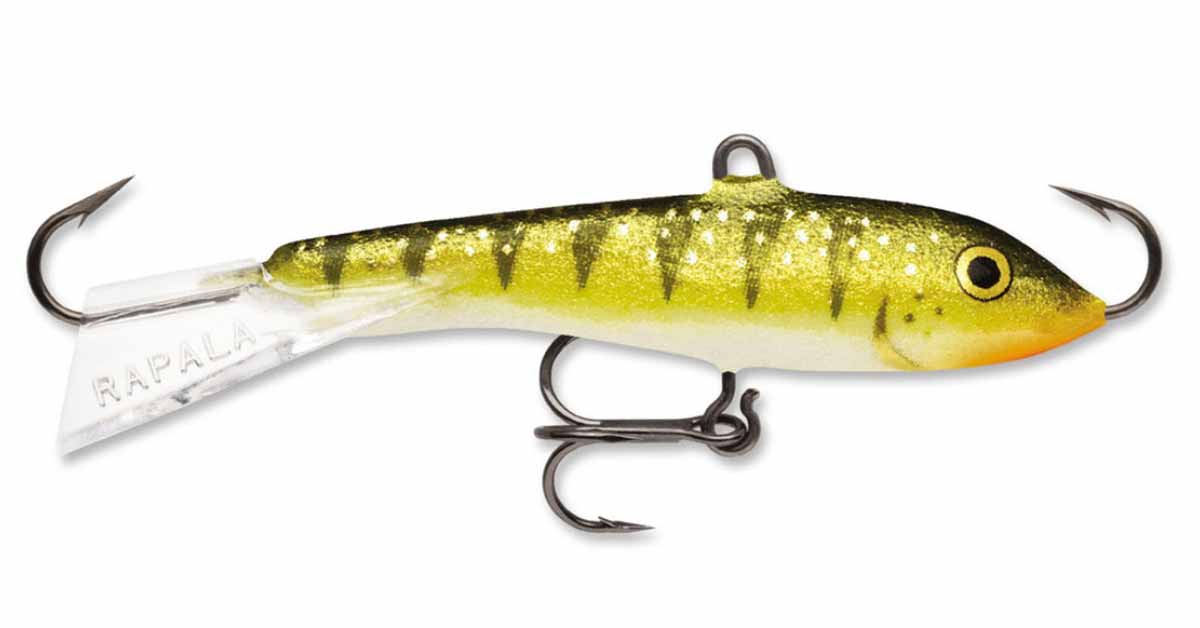
Johnson particularly likes Rapala Slab Raps and Rippin’ Raps during early ice.
These presentations can be extremely effective for perch, walleyes, and even larger crappies.
Brosdahl also favors swimming-style baits such as Puppet Minnows and other compact minnow imitations.
These lures create a distinctive action that can attract fish from a distance.
They’re particularly effective when anglers want to cover water or target aggressive fish.
One important consideration when using hard baits is hook safety.
Many swimming-style lures feature multiple exposed hooks, which can create problems when landing active fish.
Johnson is particularly cautious when guiding inexperienced anglers because an excited fish at the hole can easily result in a hook becoming embedded in someone’s hand.
Despite that consideration, both anglers recognize the effectiveness of these presentations.
Sometimes the best way to trigger a larger fish is to show it something different from the tiny jigs and spoons everyone else is using.
Fish the Entire Water Column
Another common mistake is concentrating exclusively on fish near the bottom.
Brosdahl and Johnson emphasize that fish frequently suspend at different depths, sometimes surprisingly close to the underside of the ice.
Crappies are particularly well known for suspending high in the water column.
On some lakes, large crappies may be positioned only a few feet beneath the ice, even when the total water depth is considerably greater.
Anglers who immediately drop their presentations to the bottom may never reach those fish.
Brosdahl recommends working a lure through different depths.
When using an attracting presentation such as a spoon, he may begin just beneath the ice and gradually work deeper.
This allows the lure’s flash and movement to attract fish from a larger area.
Once fish approach, he adjusts the presentation based on their behavior.
It’s a simple technique that can make a big difference when searching for scattered perch or suspended crappies.
Fishing Pressure Changes Fish Behavior
One of the more interesting aspects of the conversation involves the differences between heavily pressured metropolitan fisheries and the less-developed lakes of northern Minnesota.
Johnson spends considerable time guiding on lakes where fish encounter anglers throughout the winter.
Those fish can become sensitive to noise, movement, and repeated presentations.
On certain lakes, he avoids using a portable shelter when targeting large bluegills because the fish appear reluctant to move beneath it.
He also pays close attention to the amount of movement occurring around fishing holes.
Brosdahl encounters different challenges across northern Minnesota.
While some lakes receive substantial pressure, others provide opportunities to fish populations that see comparatively fewer anglers.
In those situations, larger presentations and more aggressive techniques can be effective.
However, both anglers caution against assuming pressured fish always require smaller lures.
Sometimes a larger spoon, different color, or more aggressive presentation is exactly what those fish need.
The important thing is recognizing patterns and adapting to the fish rather than relying on one presentation throughout the day.
Protecting Our Fisheries for Future Generations
As fishing technology continues to improve, anglers have become increasingly efficient at locating and catching fish.
That creates tremendous opportunities, but it also comes with responsibility.
Brosdahl and Johnson discussed the importance of protecting quality panfish populations.
Large bluegills are particularly valuable because they often require many years to reach trophy size.
Both anglers encourage selective harvest and releasing larger fish whenever practical.
They also discussed the challenges associated with catching crappies from deep water.
Fish brought rapidly to the surface from substantial depths can experience barotrauma, reducing their chances of survival after release.
For anglers who intend to practice catch-and-release, targeting shallower fish can be a better option.
Johnson frequently guides customers toward shallow weed-related crappies rather than concentrating on deep basin schools.
Not only can those fish provide excellent action, but fishing shallower water can reduce the risk of release-related mortality.
Brosdahl also emphasized the importance of keeping only the fish you intend to eat.
There’s nothing wrong with enjoying a meal of fresh fish.
However, harvesting every large bluegill or repeatedly targeting vulnerable schools of deep-water crappies can negatively affect a fishery.
The goal isn’t to discourage people from keeping fish.
It’s to make sure future generations have the same opportunities to enjoy quality fishing.
A Two-Species Approach to Ice Fishing Success
One final strategy worth considering is targeting more than one species during a fishing trip.
Brosdahl frequently combines daytime perch fishing with an evening walleye bite.
This allows him to enjoy consistent action throughout the day while taking advantage of prime feeding windows.
Perch are often willing biters and can provide excellent fishing during daylight hours.
As evening approaches, he shifts his attention toward productive walleye locations.
It’s a practical strategy, particularly when guiding customers who want to catch fish rather than spend the entire day waiting for one species to become active.
The same approach can work with bluegills and crappies.
Anglers might spend the afternoon fishing shallow vegetation for panfish before moving to a nearby walleye location as daylight begins to fade.
Having multiple options can make a fishing trip more productive and enjoyable.
Looking Ahead to the 2026 Ice Fishing Season
There’s plenty to be excited about as another ice fishing season approaches.
New equipment continues to make ice fishing more efficient, but as Jeremy Smith, Brian “Bro” Brosdahl, and Matt Johnson explain, technology is only part of the equation.
Successful ice fishing still requires understanding fish movements, identifying productive structure, selecting the right presentations, and paying attention to subtle details.
Sometimes that means fishing a shallow weed bed instead of an offshore hump.
Other times, it means switching from a vertical spoon to a horizontal jig or slowing your cadence just enough to trigger a reluctant bluegill.
And sometimes the best decision you can make is leaving an unsafe lake alone and finding another place to fish.
The bottom line: The 2026 ice fishing season offers plenty of opportunities for anglers willing to explore new water, experiment with different presentations, and learn from what the fish are telling them.
Stay safe, remain mobile, and remember that some of the best fishing might be a whole lot closer to shore than you think.