
Fishing has changed fast over the last few years.
Between ultra-detailed mapping, side imaging, and forward-facing sonar, anglers today can break down water and find fish with a level of efficiency that would have been hard to imagine just a few years ago. But with that progress comes a bigger conversation, one that touches tournament fishing, conservation, fish care, and what the fishing experience is supposed to feel like in the first place.
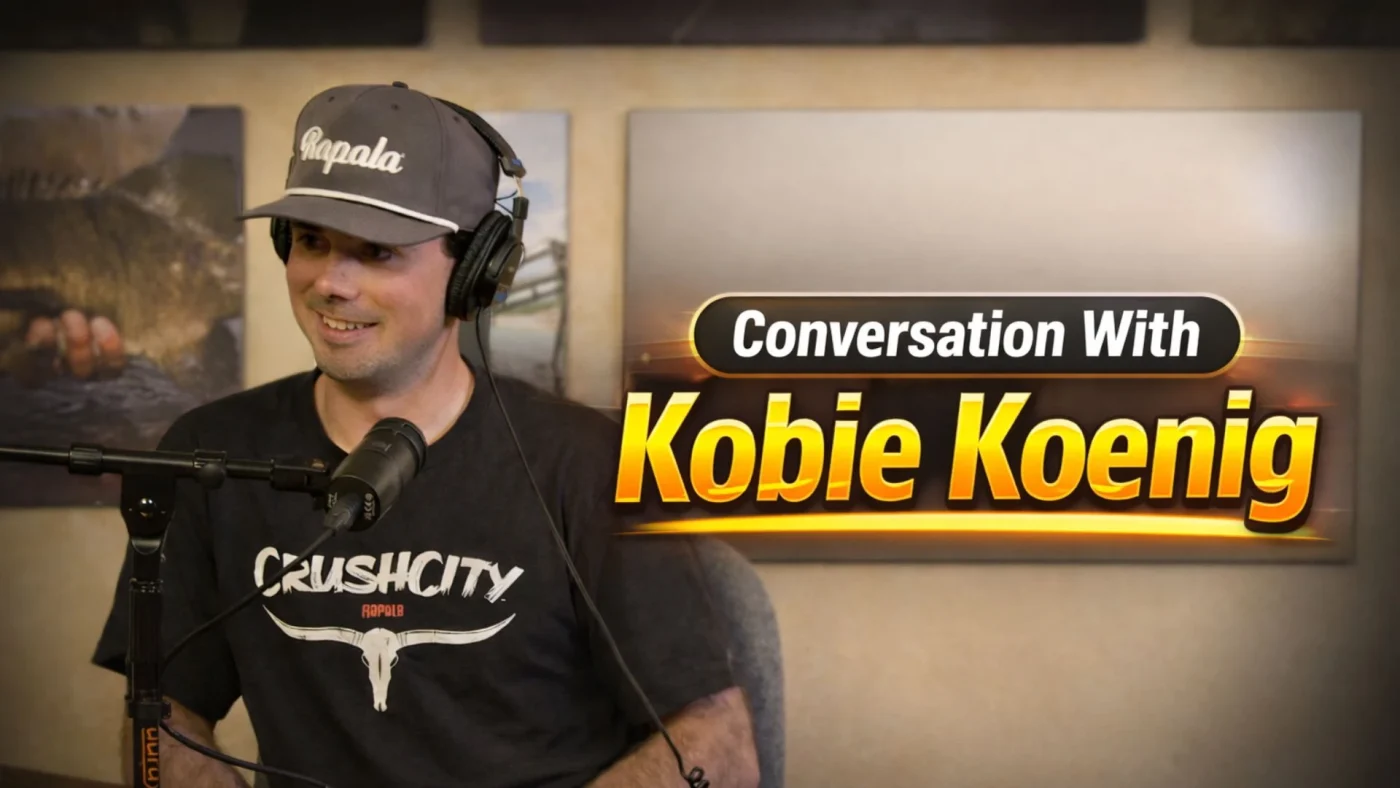
That’s what made this conversation with Kobie Koenig so good.
Kobie brings a unique perspective because he’s lived on both sides of modern fishing. He grew up in northern Minnesota fishing for whatever would bite, built his career in fishing media with Wired2Fish, and now works in content production for Rapala USA and Rapala brands. He’s spent time with some of the best anglers in the world, but he’s still grounded in the multi-species, north-country style of fishing that shaped him.
This conversation covered a lot of ground, from bass fishing and electronics to fisheries pressure and the future of sonar in fishing, and Kobie had thoughtful insight on all of it.
Who Is Kobie Koenig?
If you follow fishing media or Rapala content, there’s a good chance you’ve already seen Kobie Koenig’s work.
Kobie is from Grand Rapids, Minnesota, and his fishing roots are about as real as it gets. He grew up on North Star Lake, where his family owned a resort. Summers were spent in a small boat, learning to fish on his own and chasing anything that would bite. He talked about fishing as a kid with a walkie-talkie in the boat, checking in with his parents while he explored what felt like a huge bay at the time.
That early experience matters because it shaped the way he sees fishing today. Before bass fishing became a focus, Kobie grew up muskie fishing, and he even learned to cast a baitcaster with a muskie rod. That kind of background creates a different angler. You learn patience. You learn to fish without constant action. And you learn that the experience is bigger than just numbers.
Later, after his family sold the resort and moved back to Grand Rapids full-time, Kobie got more into bass fishing on the Mississippi River and nearby water. That transition, from muskie fishing to bass fishing, while still being around walleye and panfish, gave him the kind of multi-species foundation that a lot of northern anglers develop.
From Wired2Fish to Rapala
Kobie’s path into the fishing industry started early.
He got his first exposure to fishing media through Wired2Fish, where he started as a teenager. Like many people who build careers in this space, he began by doing whatever needed to be done, helping out, organizing gear, supporting shoots, and gradually learning the production side of the industry.
Over time, that turned into a real role in filming and editing. He spent more than seven years with Wired2Fish in different capacities, and that experience put him in the boat with a long list of elite anglers. That kind of access is hard to overstate. When you spend years watching top-level anglers break down water in different parts of the country, it changes how you understand fishing.
Now, Kobie works with Rapala USA and its brands, handling still photography and video production. His role centers heavily on product storytelling—shooting, editing, and creating content for new bait and gear launches, especially leading up to ICAST.
He also works on year-round media projects, such as the Crush City Crew series, which focuses on pro anglers and their backstories. It’s the kind of role that blends fishing knowledge with creative production, and it fits his background perfectly.
Why Minnesota Anglers Develop a Different Skill Set
One of the strongest themes in the conversation was how growing up in Minnesota shapes an angler.
Kobie and Jeremy discussed the diversity of northern fisheries, especially around Grand Rapids. In a relatively short drive, anglers can fish shield-style water, deep/clear lakes, shallow, largemouth lakes, rock, grass, current, and just about everything in between. That kind of variety builds versatility.
It’s also a multi-species culture. In a lot of southern fisheries, bass fishing is the focus 24/7. In Minnesota, most anglers grow up doing a little bit of everything: bass, walleye, muskie, panfish, and ice fishing. That matters because each species teaches something different.
Muskie fishing teaches patience and commitment. Walleye fishing sharpens your understanding of depth, structure, and fish positioning. Ice fishing builds comfort with electronics and reading fish behavior in a more direct way. Bass fishing brings the speed, patterning, and decision-making side.
Kobie also pointed out something important: high school and college fishing have changed the learning curve for young anglers.
Years ago, it could take decades to build experience across multiple regions and fishery types. Now, young anglers can travel and compete on a wide range of fisheries much earlier, especially if they fish at the high school and college levels. By the time they’re in their early twenties, some already have the kind of experience that used to take much longer to develop.
That doesn’t mean technology is doing all the work. It means anglers are getting more reps, faster, in more places.
How Kobie Koenig Breaks Down New Water
If you’re looking for practical fishing insight, this was one of the best parts of the conversation. Kobie laid out a clear process for how he approaches new water, and the biggest takeaway is simple:
Mapping comes first.
He called mapping the backbone of everything, and that’s hard to argue with. Before you worry about baits or even fish, you need to understand where you are, how the lake is laid out, where key structure exists, and how to navigate safely.
Start With Mapping
Modern mapping has changed fishing in a big way. Kobie talked about how detailed contour maps have become, including one-foot contours, and how powerful that is for identifying high-percentage areas.
He also emphasized AutoChart/custom mapping, especially for lakes that are poorly mapped or have only rough contour data. On some waters, especially in remote or less developed areas, custom mapping is just as much a safety tool as a fish-finding tool.
That’s a point a lot of anglers can relate to. Good mapping doesn’t just help you catch fish; it helps you run safely, avoid hazards, and move confidently through unfamiliar water.
Side Imaging for Fast Water Coverage
Even with forward-facing sonar in the mix, Kobie still leans heavily on side imaging when he’s trying to cover water and find the right structural pieces.
He talked about using side imaging to scan quickly and identify:
- rock spines
- transitions
- isolated boulders
- standout targets on otherwise uniform bottom
That’s a key point. On lakes with miles of rock and sand, everything can look the same until you find the little differences. Side imaging helps you find those differences fast.
He also shared a useful detail about settings: when he’s in search mode, he often runs a wider range and uses a lower frequency (455 kHz) instead of a higher-detail mega setting. The reason is simple. He’s not looking for a pretty image. He’s looking for range and coverage so he can spot big structural targets and keep moving.
That kind of adjustment is a good reminder that fishing electronics aren’t just about having the latest unit. They’re about knowing how to use the tool for the job.
Forward-Facing Sonar as a Search and Confirmation Tool
Kobie’s use of forward-facing sonar was one of the most interesting parts of the conversation because he doesn’t describe it as a standalone replacement for everything else. Instead, he sees it as part of a system.
He often scans with his trolling motor while moving, using forward-facing sonar to:
- see how structure sets up in real time
- confirm whether fish are actually on a target
- understand fish positioning before making a cast
In other words, side imaging may find the rock, but forward-facing sonar helps answer the next question: Is there a fish on it right now?
That kind of efficiency is exactly why forward-facing sonar has become such a major topic in fishing.
The Forward-Facing Sonar Debate in Fishing
There’s no way to have a real conversation about modern bass fishing without talking about forward-facing sonar.
Kobie had a balanced take on it, and that’s probably why his perspective lands so well. He’s not pretending the technology doesn’t matter. He’s also not pretending it’s the only thing that matters.
His view was clear: forward-facing sonar absolutely makes anglers more efficient, especially if they know how to use it. At the same time, great anglers are still great anglers. They still know how to break down water, make decisions, and catch fish with or without a transducer pointed forward.
That distinction matters.
Tournament Fishing and Sonar Rules
Kobie pushed back on the idea that younger anglers are only winning because they “grew up with” the technology. In his view, most anglers gained access to forward-facing sonar around the same time. The difference is who adapted to it and who didn’t.
That said, he also acknowledged the concern many anglers, especially in tournaments, have about over-reliance on screens and what that does to competition.
That’s why it’s been interesting to see major organizations start experimenting with rule changes. The conversation touched on how MLF has used period-based restrictions and transducer lockouts, creating sections of the day where anglers can’t use forward-facing sonar.
That kind of format does a few things:
- It reduces all-day dependence on sonar
- It highlights anglers who can still catch fish across different conditions
- It helps preserve some of the traditional “fish the conditions” aspect of competition
Kobie mentioned examples of top-level anglers who continue catching them even when sonar is restricted, which reinforces the point that fishing skill still matters far beyond one technology.
Fishing Technology, Conservation, and Fish Care
This was probably the most important part of the conversation.
It wasn’t just about bass fishing or tournament strategy. It was about the bigger question: What happens when anglers gain near-constant access to fish that used to be hard to target consistently?
Kobie made a strong point that not all species are affected the same way.
Not Every Fishery Faces the Same Risk
In his view, species like:
- muskie
- big walleye
- crappie/panfish (especially in winter)
may be more vulnerable to the increased efficiency of modern electronics.
That makes sense. Long-lived fish and fish that spend more time in deeper water or predictable zones can become much easier to target when anglers can see them directly and repeatedly.
Bass may be different in some cases because they’re generally more prolific and often relate to shallower water for much of the year. But even there, Kobie noted that deeper fish and certain seasonal situations can still create fish-care concerns.
Deep Fish, Tournament Stress, and Mortality
Kobie shared an example from a smallmouth tournament where fish were caught from deeper water, and even with good fish care practices, not all of them made it.
That’s a tough reality, and it’s one more reason this conversation is bigger than “technology is good” or “technology is bad.” Even when anglers are trying to do the right thing, fish care becomes more complicated as targeting efficiency increases and more fish come from deeper water.
It also reinforces something many serious anglers already know: fish care isn’t just about rules. It’s about the decisions anglers make before they ever hook the fish.
Fishing Is More Than Catching
One of the most thoughtful parts of the conversation was the idea that fishing is more than just catching fish.
That might sound obvious, but modern fishing culture doesn’t always act like it.
Kobie talked honestly about how easy it is for all of us to become focused on catching more fish, faster. The technology is there. If it helps you catch, you use it. That’s the reality.
At the same time, he also acknowledged the tension: the challenge and uncertainty are part of what makes fishing meaningful. For a lot of anglers, especially in places with strong traditions and unique fisheries, the experience matters just as much as the result.
That’s why the conversation around sonar isn’t only about numbers or tournament outcomes. It’s also about:
- what kind of fishing experience people want
- what kind of pressure fisheries can handle
- what should be preserved for the future
There probably isn’t one answer for every lake or every species. But there is value in having the conversation honestly.
Key Takeaways
This was one of those fishing conversations that goes beyond tactics.
Yes, there was plenty of good discussion on side imaging, mapping, and forward-facing sonar. But the bigger value was the perspective Kobie brought to the table, especially around the balance between efficiency, ethics, and the future of the resource.
It’s the kind of conversation that serious anglers can learn from, whether you’re into bass, walleye, muskie, or just trying to better understand where fishing is headed.