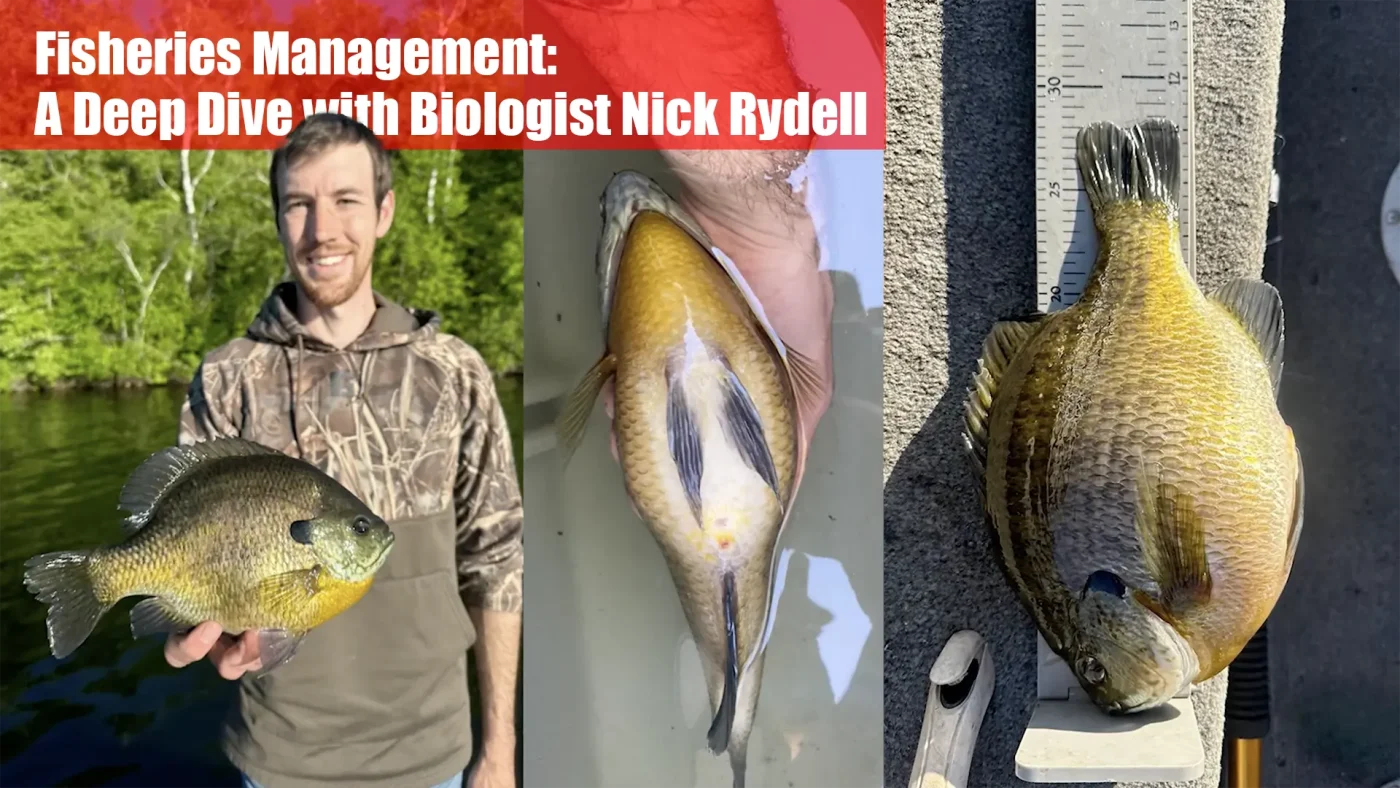

Introducing Fisheries Biologist Nick Rydell
Fisheries management isn’t just about data sheets and population reports—it’s about actively engaging with the resource. Few people embody that balance like Nick Rydell, a fisheries biologist based out of the Glenwood, Minnesota office since 2019.
In his role, Rydell serves as a “jack-of-all-trades.” His responsibilities range from education and outreach to creel surveys, muskie program work, and representation on the Panfish Technical Committee for Minnesota’s Northwest Region. Importantly, Rydell is also an avid multi-species angler. His passion for fishing helps create common ground between fisheries management and local anglers, aligning conservation with the reality of how people use the resource.
As Rydell says, “I want these lakes to be good because I’m fishing them too. I’m looking out for your best interest because it’s in my best interest.”

Spring in the Glenwood Fisheries Office
Spring is one of the busiest times of year for fisheries crews. Once the ice melts, the Glenwood team quickly shifts into high gear with multiple overlapping operations:
- Walleye production and stocking – Although the Glenwood area does not conduct a walleye egg take, their hatchery produces roughly 50 million walleye fry annually. Staff assist with egg takes at locations like Cutfoot and Spicer, then transport eggs back for hatching.
- Fathead minnow collection – Minnows are netted for muskie production support.
- Carryover fingerling stocking – A mild winter allowed for carryover walleye fingerlings to be stocked into ponds this spring.
- Panfish management – Seventeen area lakes are part of the Quality Sunfish Initiative, and targeted black crappie assessments are underway in partnership with research scientist Chris Smith.
- Muskie population studies – Crews conduct nighttime electrofishing to PIT tag fish for population estimates.
These operations run on tight timelines. “We generally work around 30 days straight in the spring,” Rydell explains.
Bass Monitoring in Spring Surveys
Bass are included in standard lake surveys, though they are more challenging to sample than species like walleye or pike. The survey process typically involves:
- Trap nets for panfish
- Gill nets for walleye, northern pike, and perch
- Electrofishing in spring, usually when water temperatures approach 60°F, coinciding with pre-spawn bass movements
Because bass often avoid nets, electrofishing is the most effective method to monitor their populations.

Weather Impacts on Spawning Success
Spring 2025 brought unusual weather patterns—a warm May with minimal runoff and little precipitation. These conditions affect spawning success across species:
- Walleye – Rely on spring runoff for both habitat improvement (shoreline gravel and cobble for spawning) and nutrient input to support fry food sources. A dry spring typically means weaker walleye recruitment.
- Crappie – Experienced multiple aborted spawning attempts due to fluctuating temperatures. Most crappies sampled were still holding eggs well into June, signaling a likely poor recruitment year.
- Bass – Some bass also remained pre-spawn later than normal.
- Bluegill – Prefer consistent warming trends and have not yet entered peak spawning. Their best reproduction occurs during steady warming periods, with water temperatures approaching 70°F.
Understanding Crappie and Bluegill Population Cycles
While both crappie and bluegill are popular panfish, their population cycles and spawning habits differ significantly.
- Crappies – Highly cyclical. Poor spawning years are common, but when conditions align, one strong year class can sustain fishing quality for years.
- Bluegills – More consistent spawners. They may spawn multiple times per year and have broader temperature flexibility, even spawning in water as deep as 17 feet in July when temperatures align.
The variability in each species’ spawning success is a key factor in management strategies like the Quality Sunfish Initiative.
Community Engagement: Alexandria Muskie Partnership
Rydell has also been proactive in community engagement, recognizing that partnerships between agencies and anglers improve both management and perception.
This winter, a conversation between local anglers, bait shop owners, and guides led to a collaborative muskie monitoring project on Oscar, Lobster, and Miltona lakes. The project uses the FishDonkey app ($5.01 entry fee) to allow anglers to log muskie catches. Anglers are encouraged to use PIT tag readers (available online for about $30) to scan tagged fish.
These angler-submitted data will:
- Improve population estimates
- Provide insights on growth, survival, and recruitment
- Support long-term muskie management strategies
As Rydell notes, “The more data we can collect, the better our estimates will be. This is a way for muskie anglers to participate in the data collection process and, in turn, make it so we can better manage our muskie waters.”
PIT-tagged muskies are not limited to these three lakes—many waters across Minnesota have tagged fish, especially from stockings since 2016. Anglers with PIT tag readers can contribute valuable information statewide.
Forward-Facing Sonar, Creel Surveys, and What the Data Really Shows
Muskie Research and Genetic Sampling
While the Alexandria muskie tournament offers valuable PIT tag data for Oscar, Lobster, and Miltona lakes, other muskie projects across the state are taking a slightly different approach. On Leech Lake, where PIT tagging isn’t widespread, researchers are supplementing population estimates with genetic sampling. This alternative method provides insight into fish abundance, survival, and recruitment trends even without a complete PIT-tagged population.
Creel Surveys: How They Work and Why They Matter
One of the most proactive steps fisheries managers have taken recently is analyzing angler behavior and technology use through Creel surveys.
A Creel survey is essentially an angler survey designed to collect data on fishing effort, catch rates, harvest, and released fish. It includes:
- Angler counts – Observers document the number of anglers fishing on a lake, either by driving or (on large lakes) aerial flyovers.
- Interviews – Creel clerks interview anglers to determine target species, catch rates, harvested vs. released fish, and trip duration.
There are two common types of Creel surveys:
- Roving Creel Surveys – Clerks travel around the lake, interviewing anglers while they are still fishing. These are typically used on small to medium-sized lakes.
- Access-Based Creel Surveys – Clerks remain at a public access, interviewing anglers as they complete their trip. These are common on large destination lakes like Mille Lacs, Leech, Red, and Lake of the Woods.
Historically, Creel surveys have focused on large walleye lakes, but since 2019, smaller and medium-sized lakes have been added. Importantly, questions about technology use—including forward-facing sonar—were incorporated to measure adoption and possible effects on catch rates.
Forward-Facing Sonar Adoption in Minnesota
Forward-facing sonar (FFS) debuted in 2015 with Garmin Panoptix, followed by LiveScope in 2018. Initial adoption was low, but by 2021, Creel surveys began consistently recording usage rates.
Key findings from 2021–2024 data (39 lakes, 39,000+ interviews):
- Usage rates are increasing rapidly – In 2023, about 10% of anglers reported using FFS. By 2024, usage doubled to ~20% statewide.
- Lake size influences adoption – Smaller lakes may have 1–2% usage, while larger lakes have recorded up to 37% usage.
- Growth drivers – Updated models and discounts on older units in 2023–2024 likely fueled a surge in adoption.
These numbers combine open water and ice fishing seasons, providing a broad snapshot of statewide use.
Does Forward-Facing Sonar Increase Catch Rates?
Rydell’s team analyzed catch rates for key species—sunfish, crappie, walleye, largemouth bass, and muskies—across both open water and hardwater seasons.
Key results:
- Open water – No statistically significant difference in catch rates between FFS users and anglers with other sonar types.
- Hardwater (ice) season –
- Roving Creels (small to medium lakes) – FFS users showed higher catch rates for sunfish, crappie, and walleye.
- Harvest rates –
- Sunfish: Statistically lower for FFS users
- Crappie: Statistically higher for FFS users (about 1 more crappie per 6.7 hours of fishing)
- Walleye: No difference in harvest rates
- Access-Based Creels (large lakes) – No statistical difference in catch or harvest rates.
The data suggests that while FFS can be an advantage under certain conditions, its biological impact at the population level may currently be limited—especially outside of smaller lakes or when used without mobility.
The “User Effect” vs. the “Technology Effect”
One of the most interesting observations from the Big Pine Lake Creel survey was the disproportionate harvest success of fishing guides.
- Guides accounted for just 5% of angler effort during the hardwater season.
- That 5% of effort produced 59% of the crappie harvest.
This supports the idea that angler skill and mobility may matter more than simply owning the technology. Experienced guides and highly skilled anglers—those already above average in catch rates—may see a bigger boost from FFS than the average angler.
Permanent Ice Houses vs. Mobility
Ice fishing behavior has also shifted over the decades:
- In the 1980s–90s – Most anglers fished open ice or in portable shelters. It was cold, mobility was necessary, and effective anglers had to work hard to stay on fish.
- Today – Permanent ice houses, with all the comforts of home, are more common. Rydell notes that catch rates in permanent houses are often low because anglers aren’t mobile.
Interestingly:
- 58% of FFS users use it in a permanent ice house.
- Interviews reveal that many stationary anglers simply watch fish on sonar 150 feet away all weekend—hoping the school moves to them rather than relocating to stay on top of the fish.
This supports the observation that comfort often outweighs mobility for many anglers. While mobile anglers with FFS (especially those in portables) can track and follow moving schools, most anglers are not using the technology to its full potential.
When you send me the next section of the transcript, I can continue this blog by diving into how these technology trends might influence management strategies—especially for high-value species like crappie, walleye, and muskie.
Forward-Facing Sonar, Angler Behavior, and Management Questions
Where Forward-Facing Sonar Is Actually Effective
While forward-facing sonar (FFS) has become a common sight on Minnesota lakes, its effectiveness depends heavily on how it’s used. Only about 10% of FFS users operate in “open ice” conditions—the scenario where mobility allows anglers to move and stay on top of fish.
In permanent ice houses, the technology often becomes more of an entertainment tool than a catch-rate booster. Anglers can watch fish in real-time on large displays, but because they aren’t moving to intercept roaming schools, their efficiency is limited. This points to the reality that angler behavior, not just the tool, determines its impact.
The Muskie Question: Low Density, High Vulnerability
The discussion often returns to muskies—a low-density, long-lived apex predator. With FFS, the probability of encountering a single, roaming muskie is dramatically higher than it was just a decade ago. While the technology might not guarantee a catch, it changes the rate of contact and therefore angler opportunity.
Currently, muskie-specific data in Minnesota Creel surveys is limited—about 700 muskie-targeted interviews so far. While early results show no statistically significant difference between FFS and other sonar users, catch rates were slightly higher among FFS users. This is preliminary, and managers expect more comprehensive analysis as more lakes and more muskie anglers are included in future surveys.
The Challenge of Data Honesty in Muskie Fishing
One of the biggest hurdles in muskie research isn’t just technology—it’s angler reporting. Muskie anglers are often reluctant to share successful trips in a public Creel survey setting. A banner day can be kept quiet to protect sensitive spots and fish.
To address this, the FishDonkey muskie tournament offers an anonymous way to report catches. Anglers submit:
- Lake name
- Fish length
- PIT tag number (if applicable)
Names and locations remain confidential, creating a trusted, low-pressure reporting method.
Even so, fisheries staff understand that angler-reported lengths can be inflated, particularly for released fish. Data from Creel surveys show panfish lengths are often overestimated by about 1 inch, and gamefish by about 2 inches. For management purposes, the assumption is that both FFS and non-FFS anglers over-report at similar rates, so comparisons remain valid.
Many Variables Affect Catch Rates—Not Just Sonar
When evaluating the role of FFS, managers face a core challenge: isolating the effect of technology from countless other variables.
Factors influencing catch success include:
- Presentation style (speed, jigging cadence, lure type)
- Angler mobility and time on the water
- Lake selection and real-time location data (LakeFinder, OnX, etc.)
- Boat capability and weather tolerance (better rain gear = longer time fishing)
In practice, FFS is one of many tools anglers use to adapt to changing conditions. While it can precisely target fish, its role must be measured alongside all other variables in the angling equation.
What the Research Shows—Minnesota vs. Other States
Rydell’s Minnesota study focuses on average users to evaluate population-level impacts, not maximum potential. Trophy targeting and “super-user” impacts may be addressed in separate studies, possibly through future University of Minnesota research.
Meanwhile, studies in other states have shown varied results:
- Arkansas (Crappie Study) – FFS users had higher catch rates, but no difference in average fish size.
- Kansas (Crappie & Blue Catfish Study) – Paired group experiments with and without FFS showed no significant difference in catch rates or fish size. Notably, both groups believed FFS was more effective, even when the data didn’t support it.
- Mississippi & Texas (Crappie Reservoir Studies) – Both states recorded statistically higher catch and harvest rates for FFS users—nearly double in some cases.
This led to an important discussion with Mississippi biologist Keith Meals: Why are southern studies showing clear differences while Minnesota’s results remain mixed?
Why Minnesota’s Results Differ
One major factor is fishing style and boat mobility. In southern crappie fisheries, boats often move slowly along visible structure or suspended fish, where FFS can track and target fish individually.
In Minnesota:
- Side imaging remains the dominant search tool. Anglers can cover hundreds of feet at higher speeds (5–7 mph) and locate fish more efficiently over broad areas.
- FFS is primarily a precision tool after fish are located, especially in open water.
- Mobile boat anglers are already effective at covering water, which may dilute the statistical advantage of FFS in Creel survey averages.
This difference in search methods and mobility may explain why Minnesota hasn’t yet observed the same population-level harvest effects as some southern states.
Comparing Southern and Northern Trends in Forward-Facing Sonar Use
Why Mississippi’s Data Looks Different
In Mississippi crappie fisheries, forward-facing sonar (FFS) usage is exceptionally high—around 70% in some lakes. That’s significantly higher than Minnesota’s ~20% adoption rate. The difference isn’t just about affordability; it’s about culture and competition.
As Mississippi biologist Keith Meals explained, crappie fishing there is comparable to SEC football—highly competitive, with weekly tournaments and a strong guide presence. These fisheries primarily hold white crappies, which are often pelagic in reservoirs and more vulnerable to FFS than Minnesota’s black crappies, which relate more to vegetation and structure.
In these environments:
- Over 20% of angling pressure may come from guides.
- Competitive anglers are often super-users, fishing with advanced technology and targeting high-value fish.
- Tournament results demonstrate the quality of these fisheries—like a 2.9 lb average in a Crappie Masters event.
Minnesota certainly has its share of super-users and skilled anglers, but these impacts aren’t as visible in statewide averages because they are concentrated among a smaller subset of anglers.
The Guide Data Gap
Minnesota currently has no licensing requirement for fishing guides, meaning:
- The total number of guides in the state is unknown.
- The impact of guide activity on fish harvest is poorly quantified.
Rydell’s Creel data illustrates the potential significance: On Big Pine Lake, guides represented 5% of angler effort but accounted for 59% of the crappie harvest during winter.
Guides provide tremendous value:
- Introducing new anglers to fishing
- Driving local economies
- Selling fishing licenses and equipment
However, from a resource management standpoint, better tracking of guide activity could:
- Provide clearer data on super-user harvest impacts
- Support fair resource allocation conversations
- Improve management decisions based on real fishing pressure
The Social Side of Forward-Facing Sonar
While Rydell’s data shows no alarming population-level harvest impacts so far, the social response to FFS is mixed. Many anglers express discomfort or opposition to its use, particularly on smaller or sensitive lakes.
This raises an important distinction:
- Biological Management – Based on data, current FFS use doesn’t require emergency harvest regulations.
- Social Management – Angler perception, lake-use conflicts, and equitable access may justify selective restrictions or adaptations.
Potential examples of situation-specific regulations:
- Limiting FFS use during certain seasonal windows (e.g., spawning periods for highly targeted species)
- Restricting FFS during specific events (e.g., tournament fishing on smaller lakes)
- Maintaining open discussion and data-sharing between anglers, guides, and managers
The real challenge: Technology and information exchange are advancing faster than regulation. With Minnesota’s typical regulatory process taking around two years, proactive monitoring is key.
Pike and Bluegill Management: Predator Balance and Size Structure
Northern Pike Management: Zone Regulations in Action
Minnesota’s 2018 zone regulations for northern pike created targeted management tools for different regions. In the Glenwood area, the rules include:
- Bag limit – 10 pike
- Protected slot – 22–26 inches
- One over – One fish allowed over 26 inches
The goal: Encourage harvest of small pike while protecting larger fish that play a key role in population balance.
Early signs:
- Fast-growth lakes are showing more pike over 30 inches than in recent decades.
- Large pike help control small pike populations through cannibalism.
- The overall biomass of pike in a lake remains constant—whether it’s 100 one-pound fish or 20 five-pound fish—but shifting that biomass toward larger individuals creates a healthier size structure.
However, in slow-growth lakes, change will take much longer. Studies show that angler harvest alone is rarely enough to reduce small pike populations without protecting the largest predators.
Bluegill Management: Protecting the Bulls
Bluegill management is one of the most complex and fascinating challenges in fisheries biology. The Quality Sunfish Initiative aims to improve size structure by protecting the largest, most valuable males—the nest builders who drive population genetics.
Bluegill males follow different reproductive strategies:
- Bull males – Delay maturity, grow large, build and defend nests
- Sneaker males – Mature at small sizes, sneak in to fertilize eggs without nest building
- Satellite males – Resemble females, enter nests to fertilize without territorial defense
Why this matters:
- Harvesting large bull males removes the genetic incentive for delayed maturity.
- Over time, this shifts the population toward smaller, earlier-maturing fish, reducing overall size quality.
Management takeaway:
- Harvest smaller bluegills (ideally under 8.5 inches)
- Release large bull males to maintain strong size genetics
Quality Sunfish Initiative: Protecting Big Bluegills
The Quality Sunfish Initiative was never about restricting anglers from catching bluegills—it was about protecting the largest, most valuable individuals so lakes can continue producing them.
In slower-growth areas like the Brainerd Lakes region or Grand Rapids, once large bluegills are removed, it can take decades for size structure to recover. These fish are rare, and protecting them is essential to sustaining trophy-quality opportunities.
While five-fish bag limits on designated lakes are an important step, the biological challenge isn’t recruitment of sunfish—it’s recruitment of large fish into the fishery. Slot limits, which are being tested in some areas (e.g., “keep 20, but only five over eight inches”), may provide a more targeted approach in the future.
A Rare Catch: Minnesota’s New Certified State Record Bluegill
One of the highlights in recent years for Minnesota panfish came when Nick Rydell himself landed the new certified state record bluegill.
Details of the catch:
- Length – 11 ¼ inches
- Girth – 13 ¼ inches
- Weight – 1 lb 13 oz
This fish set the certified record under new documentation rules implemented for 11 species, replacing a historic benchmark from 1948 (Alice Lake, Hubbard County, 2 lbs 13 oz). While Rydell humbly acknowledges that the earlier record was likely legitimate, the significance of his fish lies in proving that truly exceptional bluegills still exist in Minnesota waters.
Such catches underline the importance of modern management practices. By protecting top-end fish, lakes can continue producing rare specimens like this one—true trophies for the anglers who dedicate the time and stewardship to find them.
Closing Thoughts
From forward-facing sonar adoption to muskie PIT tagging, from pike biomass management to quality bluegill protection, fisheries management is a balancing act between science, social values, and evolving technology.
Biologists like Rydell represent a new generation of managers who combine:
- Hands-on fishing experience
- Analytical, data-driven decision-making
- Proactive engagement with anglers and communities
The result is a more informed, collaborative approach to managing Minnesota’s diverse fisheries. While the science continues to evolve, one truth remains: strong partnerships between anglers and managers are the key to sustaining high-quality fishing opportunities for future generations.