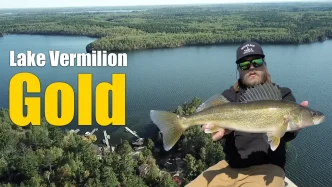


Lake Vermilion stands as one of Minnesota’s premier walleye gold fisheries—massive in size, incredibly rich in structure, and teeming with fish of all sizes. Anglers who have experienced it firsthand know there’s something special about this lake that keeps them coming back. Here we dive into what makes Vermilion so unique, the seasonal strategies that work, and practical tips for fishing walleyes in the lake’s abundant weed beds. Every visit here reinforces the reputation of Lake Vermilion as a true hotspot for walleye gold.
The Draw of Lake Vermilion: Walleye Gold
What brings anglers to Lake Vermilion? The answer is simple: fish—lots of them. And in particular, walleye gold fillets. The lake offers an overwhelming amount of quality habitat, and nearly every bay or point looks fishy. Anglers often catch 20 walleyes in a single area, only to return the next morning and find even more stacked up. This speaks to the incredible biomass of the lake and how fish constantly move and replenish spots.
Vermilion offers walleyes of all sizes, from eaters to true trophies. Thanks to a strong population structure, there’s no shortage of fish in the 20–26″ range, and big fish—those pushing 28″ and beyond—are not just possible, they’re caught with impressive regularity.
Slot Limits and Conservation Payoffs
One reason for Vermilion’s consistency is its thoughtful fishery management. It’s a four-fish limit lake, not six like some others, and it has a protected slot that requires releasing walleyes between 20 and 26 inches. On the west side of the lake, especially in June, anglers routinely catch multiple fish within that slot every day. It’s not uncommon to land a few 22s or 24s, and occasionally even fish over the slot limit.
In fact, one memorable outing produced five fish over 28 inches, with the largest stretching to 29¼ inches—a feat that’s incredibly rare outside of destinations like Lake of the Woods. While lakes like Mille Lacs, Winnie, and Leech may produce a few giants, Vermilion stands out as one of the top five walleye lakes in the state.
Seasonal Movements and Preferred Zones
As the open-water season progresses, fish movements on Vermilion are noticeable. Early in the year, especially in May and June, the west side of the lake is typically more productive. This region offers extensive shallow-water habitat with strong weed development—something that’s less prevalent on the east side.
One underutilized pattern on the lake is fishing walleyes in the weeds. It’s especially effective in spring, but the weed bite can produce all season long. While traditional walleye thinking often revolved around rocks and gravel flats, today’s anglers are well aware of how valuable weed edges and pockets can be—especially on a lake like Vermilion.
Fishing Weeds: From Taboo to Staple
Years ago, many anglers didn’t fully understand how to target walleyes in the weeds. Now, it’s become a fundamental part of the playbook. In places like Brainerd—where many walleye anglers cut their teeth—weed lines have always been a key focus. But as electronics and techniques improve, it has become even easier to locate and fish these overlooked areas.
Guiding Strategies: Simple, Fun, and Effective
When guiding novice anglers on Vermilion, simplicity and fun are essential. One of the most effective and user-friendly techniques is slip bobber fishing with leeches. It’s not just effective for walleyes—it catches bluegills, bass, and a wide range of other species, which keeps everyone in the boat engaged and happy.
A close second in effectiveness is jig fishing with live bait. But when targeting walleyes specifically in and around weed beds, slip bobbers shine. Fishing them in pockets, on edges, and even around shallow rocks can be devastatingly effective. Many pros lock into the slip bobber bite for a solid two months each season, using a leech under a float as their go-to method.
The Cost of Catching: Live Bait Matters
If you’re committed to this kind of fishing, live bait becomes a serious investment. He estimated spending about $3,500 on leeches in a single season. The following year, they switched to nightcrawlers and bought nine flats—roughly 4,500 crawlers in total. It’s a testament to how valuable—and how heavily used—live bait is in successful Vermilion walleye strategies.
Final Thoughts
Lake Vermilion is not just big—it’s biologically rich, smartly managed, and full of opportunity for anglers of all skill levels. Whether you’re a seasoned veteran looking for trophy walleyes or a first-timer hoping to catch anything that bites, Vermilion offers a fishery as diverse and dependable as any in the Midwest. From weedline slip bobbers to flats crawling jigs, this lake truly has it all.